



Aliko Dangote: Africa’s Industrial Titan and the Man Reshaping the Continent’s Energy Future
Aliko Dangote is widely recognized as one of Africa’s most influential industrialists, having built a vast business empire spanning cement, sugar, salt, flour, and energy. His story is often told as a classic example of ambition transforming opportunity into industrial dominance. From trading small goods in Kano, Nigeria, to leading one of the continent’s largest conglomerates, Dangote’s journey reflects both personal vision and Africa’s evolving economic landscape.
However, while viral narratives often exaggerate certain figures—especially net worth and refinery output—the core story of Dangote’s rise is firmly rooted in documented business expansion, strategic acquisitions, and large-scale industrial investment.
Early Life and Family Background in Kano
Aliko Dangote was born on April 10, 1957, in Kano, northern Nigeria, into a wealthy and influential trading family. Contrary to the “rags-to-riches” simplification often used in storytelling, Dangote did come from a commercially established lineage.
His maternal lineage is especially significant in West African commerce history. His great-grandfather, Alhassan Dantata, was one of the wealthiest merchants in West Africa during the early 20th century, widely recognized for his dominance in commodities trading.
Despite this background, Dangote’s immediate inheritance was not equivalent to vast liquid wealth. Like many large extended trading families, wealth was distributed across multiple heirs, and his early life still required discipline and business learning.
Tragedy struck early when his father died while Dangote was still a child. He was raised under the guidance of his maternal grandfather, Sanusi Dantata, who played a formative role in his upbringing and business mindset.
Education and Early Business Mindset
Dangote’s education included attendance at Capital High School and Government College in Birnin Kudu. He later pursued higher education at Al-Azhar University in Cairo, Egypt, where he studied business-related disciplines and graduated in 1977.
Even before formal business ventures, Dangote demonstrated early commercial instincts. He has often recounted buying goods like sweets in bulk and reselling them to classmates for profit. While this anecdote is commonly used in entrepreneurial storytelling, it reflects a broader truth seen in many successful business figures: early exposure to trade and pricing dynamics.
The Launch of the Dangote Group (1977)
After returning to Nigeria in 1977 at around age 21, Dangote reportedly began his business journey with a loan of approximately $3,000 from a family member. He used this capital to establish what would become the Dangote Group.
Initially, the company focused on trading commodities such as:
- Sugar
- Cement
- Flour
- Salt
- Rice and other consumer goods
At the time, Nigeria was heavily dependent on imports for basic goods, creating strong demand for import-based trading businesses.
Dangote’s early success came from efficient distribution and reinvestment. Within a short period, he was able to repay his initial loan and expand operations.
Nigeria’s Economic Environment and Strategic Shift
During the 1980s and 1990s, Nigeria experienced significant political instability, including military rule, currency fluctuations, and inconsistent economic policies. These conditions made manufacturing difficult but also created opportunities for import substitution.
Dangote’s key strategic insight was simple but powerful:
Nigeria should not depend permanently on imported basic goods.
Instead of remaining a trader, he began transitioning toward local manufacturing.
This shift marked the foundation of his long-term industrial dominance.
Expansion into Cement: The Foundation of the Empire
One of the most important turning points in Dangote’s business history was his entry into cement manufacturing.
In 2000, the Dangote Group acquired the Benue Cement Company from the Nigerian government as part of privatization reforms. This acquisition marked the beginning of aggressive expansion into industrial production.
By 2003, the Obajana Cement Plant in Kogi State was commissioned. This facility became one of the largest cement plants in sub-Saharan Africa and remains a cornerstone of Dangote Cement’s production capacity.
Dangote Cement’s Impact
Dangote Cement has grown to become:
- One of Africa’s largest cement producers
- A dominant supplier in Nigeria’s construction sector
- A major exporter to multiple African countries
It is frequently reported to control a significant share of Nigeria’s cement market, making it a key player in infrastructure development across West Africa.

Net Worth: Clarifying the Real Numbers
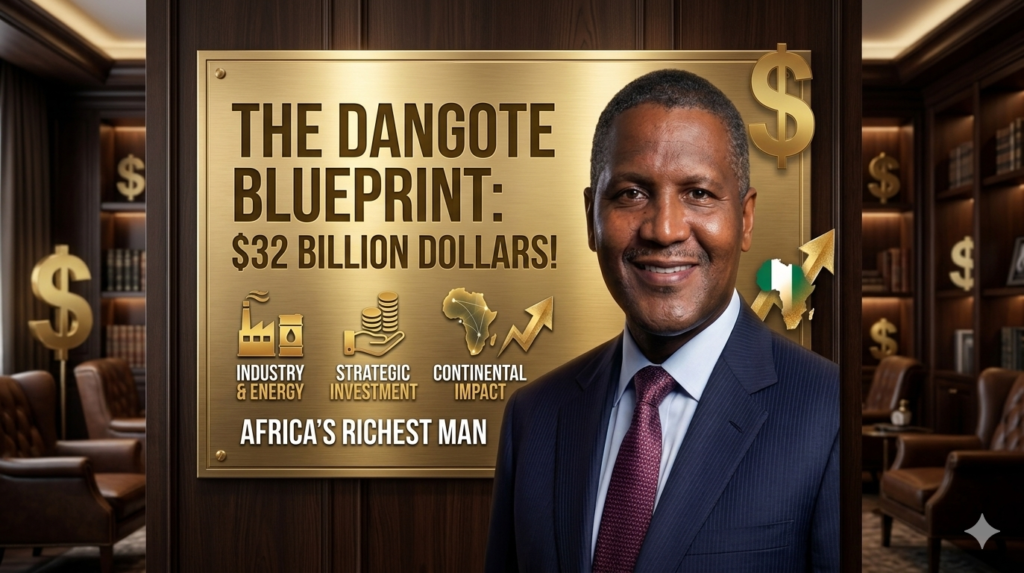
Viral content often claims that Aliko Dangote’s net worth has reached over $30 billion or more. However, it is important to clarify that billionaire wealth estimates fluctuate significantly based on:
- Currency valuation (especially the Nigerian naira)
- Stock market performance
- Asset valuation changes
According to widely tracked global financial rankings such as the Bloomberg Billionaires Index and Forbes estimates in recent years, Dangote’s net worth has generally fluctuated in the range of approximately $10 billion to $20 billion, rather than consistently exceeding $30 billion.
Claims of a $32.5 billion net worth should therefore be treated as unverified or highly variable estimates, not stable financial fact.
The Rise of the Dangote Group
Today, the Dangote Group is one of the largest industrial conglomerates in Africa.
Its business interests include:
- Cement production
- Sugar refining
- Salt processing
- Flour and pasta production
- Fertilizer manufacturing
- Oil refining and petrochemicals
- Real estate investments
The group operates across multiple African countries, including Ghana, Ethiopia, Togo, Cameroon, Benin, Zambia, and others.
It is also widely reported that the company employs tens of thousands of people directly and indirectly, making it a significant contributor to employment in the region.
The Dangote Refinery: Africa’s Most Ambitious Industrial Project
One of Dangote’s most ambitious projects is the Dangote Refinery located in the Lekki Free Zone near Lagos, Nigeria.
Project Overview
- Location: Lagos, Nigeria (Lekki Free Zone)
- Capacity: 650,000 barrels per day (initial phase)
- Investment: Estimated over $15–20 billion
- Type: Single-train refinery (one of the largest of its kind globally)
The refinery was designed to address a long-standing contradiction in Nigeria’s economy:
Nigeria produces crude oil but historically imported refined petroleum products.
This created heavy foreign exchange pressure and dependence on external suppliers.
Why the Refinery Matters
If fully optimized, the Dangote Refinery has the potential to:
- Reduce Nigeria’s fuel imports
- Stabilize domestic fuel supply
- Strengthen foreign exchange reserves
- Supply refined petroleum products to West Africa
Reports from 2024–2025 indicate that the refinery has already begun partial operations and started supplying petroleum products to some African markets. However, export volumes and expansion timelines continue to evolve and should be interpreted cautiously, as industrial ramp-up of this scale takes years.
Expansion Plans and Future Capacity
Dangote has publicly indicated plans to expand refinery capacity beyond its initial design, with figures such as 1.0 to 1.4 million barrels per day being discussed in industry reporting.
If achieved, this would potentially make it:
- One of the largest refineries in the world
- A major energy supplier across Africa
However, such expansion projects depend on engineering scaling, financing, and long-term operational stability, and should not be considered guaranteed outcomes.
Leadership Style and Work Ethic
Aliko Dangote is often described as highly disciplined, with reports suggesting he maintains long working hours and remains actively involved in business strategy even at age 60+.
He is known for:
- Hands-on decision-making
- Long-term industrial planning
- Reinvestment of profits into infrastructure
- Focus on local production rather than imports
His approach reflects a broader philosophy of industrial self-sufficiency for African economies.
Economic Impact Across Africa
Dangote’s businesses have had significant economic effects, particularly in West Africa:
- Reduced reliance on imported cement
- Expanded local manufacturing capacity
- Created large-scale employment opportunities
- Increased intra-African trade in industrial goods
The Dangote Group has also contributed to regional infrastructure development by supplying essential materials for construction and energy sectors.
Challenges and Criticism
Despite its success, the Dangote empire is not without criticism or challenges:
- Market dominance concerns in some sectors
- Heavy reliance on regulatory relationships
- Currency and import/export volatility risks
- Large-scale project financing pressures
Mega-industrial projects like the refinery also face operational challenges, including logistics, crude supply agreements, and regional distribution systems.
Conclusion: A Legacy Still in Progress
Aliko Dangote’s story is not just about wealth—it is about industrial transformation in Africa. While viral narratives often inflate numbers or simplify his journey, the verified facts still present an extraordinary picture.
He has built one of Africa’s most powerful conglomerates and is actively reshaping the continent’s energy and manufacturing landscape. Whether through cement production or refining petroleum, Dangote’s influence extends far beyond Nigeria.
And importantly, his most ambitious project—the Dangote Refinery—represents a shift toward African industrial self-sufficiency that is still unfolding in real time.
FAQ Section
1. What is Aliko Dangote’s net worth?
Estimates vary, but most major financial indexes place his net worth between $10 billion and $20 billion, depending on market conditions.
2. What is the Dangote Refinery?
It is a large-scale oil refinery in Nigeria designed to process up to 650,000 barrels of crude oil per day in its initial phase.
3. Is Dangote the richest man in Africa?
He is consistently ranked among Africa’s richest individuals, often holding the top position depending on market fluctuations.
4. What does Dangote Group produce?
The group produces cement, sugar, salt, flour, pasta, fertilizer, and petroleum products.
5. Where is Dangote Cement located?
It operates major plants across Nigeria, with the Obajana plant being one of the largest in Africa.
6. Why is the Dangote Refinery important?
It reduces Nigeria’s dependence on imported fuel and strengthens Africa’s refining capacity.