



Monuments of Mind and Mineral: How the Grand Egyptian Museum Resurrects the Foundations of Global Civilization
Imagine standing at the precipice of the modern world with one foot planted firmly in an antiquity older than human memory itself. Before you, a striking expanse of glass, steel, and sculpted stone rises from the desert sands, while just two kilometers away, the Great Pyramids of Giza stand silent, monolithic, and eternal. This architectural convergence marks the realization of a moment the cultural world has anticipated for decades.
Following a highly anticipated partial opening on October 16, 2024, the true moment of global inauguration arrived on November 1, 2025. The Grand Egyptian Museum (GEM) was officially fully inaugurated in a historic, state-level ceremony outside Cairo. Broadcasted globally, the event was far more than a localized ribbon-cutting; it functioned as a planetary cultural event.
Covering over 500,000 square meters, GEM stands as the largest archaeological museum complex on Earth dedicated exclusively to a single civilization. Yet, the unstoppable international hype surrounding its opening does not stem merely from its physical footprint. GEM is powerful because it does not operate as a passive warehouse for the dead; it stands as a living, modern monument to the oldest advanced society in human history, forcing the 21st century to completely re-evaluate the meaning of the word “ancient.”
The Monolithic Welcome: Power, Dynasty, and the Shadow of Ramses II
The structural layout of the Grand Egyptian Museum is intentionally designed to impose a profound psychological shift upon the visitor the exact moment they cross the threshold.
Museum Entrance Experience:
[ Grand Atrium Entry ] ---> Massive 3,200-Year-Old Statue of Ramses II ---> Direct Immersion into Pharaonic Divinity
The Colossus of the Atrium
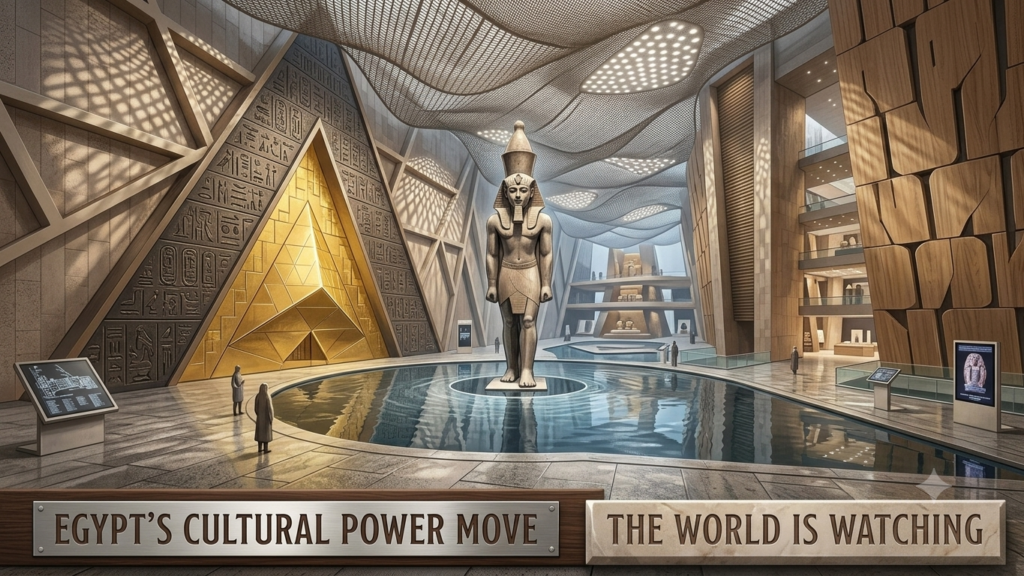
Standing as the absolute centerpiece of the grand atrium is a colossal, 83-ton, 3,200-year-old red granite statue of Pharaoh Ramses II. Discovered in Akhmim and painstakingly relocated to the site, this towering monument is positioned so that the pharaoh welcomes every traveler. Placing Ramses II at the vanguard is a deliberate thematic choice. He represents the peak of the New Kingdom’s imperial might, military conquest, and architectural ambition.
Chronological Cartography of Empire
Beyond the atrium, the museum’s main galleries are mapped out as a chronological journey through the three macro-eras of pharaonic history. Visitors move seamlessly across distinct societal transformations:
The Old Kingdom: The foundational age of absolute centralized authority, pyramid architecture, and structural consolidation.
The Middle Kingdom: A profound classical renaissance defined by a resurgence in literature, fine arts, and regional administrative reorganization.
The New Kingdom: The cosmopolitan imperial era marked by international military expansion, vast wealth accumulation, and legendary rulers who interacted heavily with the broader Mediterranean and Near Eastern worlds.
By arranging these eras across an expansive layout, the museum illustrates how the pharaohs operated not merely as secular statesmen, but as physical links between the terrestrial world and the cosmic order.
The Boy King’s Legacy: The Complete Treasures of Tutankhamun
While the museum covers three millennia of continuous history, the undisputed focal point of international fascination is the dedicated exhibition wing housing the legacy of Tutankhamun.
+------------------------------------+---------------------------------------+
| Historical Exhibition Paradox      | GEM Unified Exhibition Standard       |
+------------------------------------+---------------------------------------+
| Artifacts split across global sites| Complete 5,000+ item hoard unified    |
| Focus restricted to gold & jewelry | Full lifestyle context (chariots, toys)|
| Storage constraints hid minor items| Specialized micro-climate conservation|
+------------------------------------+---------------------------------------+
Unifying the Hoard
For more than a century since Howard Carter first breached the steps of tomb KV62 in the Valley of the Kings in 1922, the boy king’s treasures were fractured. Portions of the collection toured the globe, while hundreds of delicate organic pieces remained sealed away in the overcrowded basements of the historic Tahrir Square museum. GEM has permanently upended this historical fragmentation. For the first time in human history, the entire funerary hoard—numbering over 5,000 original artifacts—is displayed together in a singular space.
A Life Frozen in Gold and Wood
The exhibition layout allows visitors to walk through the complete context of a royal life cut short. The display features the iconic solid-gold inlaid death mask, alongside his ceremonial military chariots, gilded thrones, ritual weaponry, and ornate walking sticks.
Crucially, the collection also highlights the mundane, deeply human items that accompanied the young ruler to his grave: childhood toys, linen garments, preserved food containers, and game boards. This massive display transforms Tutankhamun from an abstract geopolitical symbol into a tangible human being frozen in time.
The Architecture of Information: Hieroglyphs, Scribes, and the Papyrus Record
A major portion of GEM’s internal curatorial focus is dedicated to dismantling the myth that hieroglyphs were simple, primitive picture-writings. Instead, the museum frames the ancient Egyptian language as a highly sophisticated, multi-layered cognitive tool that permanently altered human communication.
Ancient Communication Framework:
[ Ideograms / Logograms ] ───> Representation of Physical Concepts
[ Phonograms / Symbols ]  ───> Complex Phonetic Sound Structures
[ Determinatives ]        ───> Contextual Semantic Classification
Hieroglyphs functioned as the sacred grammar of the state. Every meticulously carved falcon, open eye, coiled snake, and extended hand carried profound phonetic, symbolic, and religious weight. Scribes and priests—who occupied the absolute peak of the educated bureaucratic class—utilized this linguistic system to record the structural mechanics of an empire.
The museum displays an unparalleled collection of ancient papyrus scrolls, preserving everything from sacred temple spells and complex funerary prayers to mundane administrative tax ledgers, royal battle reports, and intimate love poetry. By showcasing the evolutionary links between these early writing systems and modern alphabetic scripts, the museum illustrates a direct, unbroken line from pharaonic scribes to modern literacy.
Ancient Innovation: Deconstructing the Engineering of the Impossible
For centuries, popular culture has wrapped the construction of the Great Pyramids in pseudoscientific mystery. The Grand Egyptian Museum addresses this enduring curiosity directly, substituting romantic speculation with rigorous, empirical archaeological evidence of advanced ancient industrial technology.
           [ Pharaonic Civil Engineering ]
                          │
         ┌────────────────┼────────────────┐
         ▼                ▼                ▼
   [ Hydraulics ]      [ Astronomy ]     [ Geodesy ]
Logistical Transport Stellar Alignment  Nile Flood Management
 & Canal Systems     & Cardinal Precision  & Urban Drainage
Through the display of original copper chisels, massive plumb bobs, measuring ropes, and structural optical devices, GEM illuminates the profound mechanical intelligence of the Nile Valley architects. The exhibitions outline how Egyptian builders utilized complex systems of:
Advanced Hydraulics: Diverting the seasonal floodwaters of the Nile into specialized artificial canal networks to float multi-ton blocks of limestone and Aswan granite directly to the base of construction zones.
Leverage and Ramps: Designing dynamic, modular ramp systems that distributed weight efficiently across massive vertical steps.
Astronomical Alignment: Using precise stellar measurements to align the cardinal faces of the Giza monuments with margins of error under a fraction of a single degree.
These displays prove that the pyramid builders were not primitive laborers driven by brute force, but master mathematicians, urban planners, and civil engineers whose structural standards laid the groundwork for modern construction.

The Pantheon of Eternity: Cosmic Order and the Afterlife
To understand the political durability of ancient Egypt, one must understand its spiritual framework. Religion was not an isolated aspect of daily life; it was the foundational law that governed the state. The pharaoh acted as the living avatar of Ma’at—the cosmic principle of truth, balance, order, and justice.
       [ Pharaoh: Sovereign of Ma'at ]
                      │
       ┌──────────────┴──────────────┐
       ▼                             ▼
[ Terrestrial Sphere ]     [ Celestial Sphere ]
 Crook, Flail, & Crown      Ankh, Ra, & Osiris
The museum showcases the intricate symbolic regalia through which this divine authority was communicated. Rulers held the crook and flail to signify pastoral guidance and absolute enforcement, wore the double crown (Pschent) to project sovereignty over Unified Egypt, and surrounded themselves with sacred icons like the Ankh (the key of life) and the Eye of Horus (the symbol of royal protection).
GEM’s religious galleries detail the complex roles of the pantheon: Ra, the solar source of life; Osiris, the lord of resurrection; Isis, the matrix of magic; and Anubis, the guardian of the mummification ritual. By demonstrating how these concepts of moral judgment and spiritual eternity influenced neighboring Mediterranean cultures, the museum highlights Egypt’s status as a foundational pillar of global religious thought.
The War Machine: The Rise of an International Military Superpower
While the public imagination frequently associates ancient Egypt with peaceful agrarian lifestyle and spiritual meditation, GEM dedicates a substantial gallery space to illustrating its status as an aggressive, highly organized military superpower.
+---------------------------+-----------------------------------+
| Military Innovation       | Strategic Application             |
+---------------------------+-----------------------------------+
| Composite Bow Integration | Long-Range Kinetic Penetration     |
| Light Tactical Chariot    | High-Speed Outflanking Maneuvers  |
| Organized Command Cadre   | Multi-Divisional Strategic Assault|
+---------------------------+-----------------------------------+
During the New Kingdom, pharaohs like Thutmose III and Ramses II transformed the military from a defensive militia into a professional, mobile standing army. The museum displays beautifully restored combat equipment, including scaled bronze armor, heavy slashing swords (khopesh), reinforced shields, and light, dual-occupant war chariots optimized for speed.
Crucially, the exhibits reveal how these pharaohs used monumental architecture as early forms of geopolitical propaganda. Massively scaled relief carvings depicting victories like the Battle of Kadesh were carved across temple walls. These served as deliberate visual statements of absolute state power, demonstrating an early understanding of political image control and strategic psychological warfare.
Our Pharaonic Inheritance: The Invisible Blueprint of Modernity
One of the most profound realizations driven by the GEM experience is the realization of just how much contemporary human society has directly inherited from the Nile Valley. The museum acts as a mirror, showing visitors that their daily routines were structured thousands of years ago.
Global Structural Inheritance Lifeline:
[ Egyptian Calendar ] ───> 365-Day Solar Cycle ───> Modern Gregorian System
[ Agrarian Science ]  ───> Crop Rotation & Canals ───> Contemporary Irrigation
[ Civil Bureaucracy]  ───> Centralized Archive    ───> Modern State Administration
The civil calendar used by the modern world—dividing the solar year into 365 days and twelve months—is a direct evolution of the astronomical calculations made by Egyptian priests tracking the heliacal rising of the star Sirius.
From the development of advanced surgical techniques, specialized medical tools, and systematic anatomical knowledge to the creation of centralized libraries, formal legal codes, grid-based urban planning, and complex agricultural irrigation matrices, the pharaohs did not merely build an isolated empire; they wrote the baseline blueprint for global civil infrastructure.
The Science of Preservation: A Global Hub for Modern Egyptology
Beyond its status as a premier tourist destination, the Grand Egyptian Museum functions as an international epicenter for cutting-edge archaeological science and restoration.
       [ GEM Conservation Infrastructure ]
                       │
       ┌───────────────┴───────────────┐
       ▼                               ▼
[ Non-Invasive Diagnostics ]     [ Environmental Safeguards ]
X-Ray Radiography & 3D Scanning   Sustainable Micro-Climate Units
The complex features a network of 17 specialized conservation laboratories equipped with state-of-the-art diagnostic technology. Here, international researchers utilize non-invasive digital scanning, chemical spectroscopy, and precise environmental monitoring to analyze fragile textiles, organic wood elements, and ancient pigments without risking physical degradation.
By analyzing artifacts excavated over a century ago with modern forensic tech, scientists are continually decoding hidden layers of history—uncovering forgotten trade routes, ancient chemical formulas, and genetic lineages. GEM ensures that Egyptology remains an active, evolving science of discovery.
Sustainable Legacy: Engineering for the Next 5,000 Years
Constructing a massive, hyper-modern museum complex immediately adjacent to a fragile desert ecosystem presents severe environmental and logistical challenges. To address these concerns, GEM was engineered from the ground up around strict principles of ecological sustainability and structural preservation.
           [ Sustainable Engineering Matrix ]
                          │
         ┌────────────────┴────────────────┐
         ▼                                 ▼
[ Passive Thermal Mass ]         [ Active Smart Micro-Climates ]
High-Density Stone Shading        Independent Variable Air Volume
 Reduces HVAC Power Demands        Protects Sensitive Organic Material
The building’s signature translucent alabaster facade and high-density concrete walls provide massive thermal insulation, absorbing the intense desert heat during the day and radiating it away at night to reduce the building’s cooling energy loads.
Inside the exhibition halls, ultra-precise, zoned micro-climate control systems maintain independent levels of relative humidity and temperature tailored specifically to the unique material composition of each gallery. By integrating these green systems with advanced seismic monitoring and strict tourist flow management protocols, the designers of the Grand Egyptian Museum have guaranteed that Egypt’s ancient legacy is fully protected for the next 5,000 years.
Frequently Asked Questions
What are the exact milestones of the Grand Egyptian Museum’s opening?
The Grand Egyptian Museum underwent a strategic two-phase opening process. It initially granted the public a limited first look during a partial opening on October 16, 2024. The official, full state inauguration of the entire museum complex took place during a massive global ceremony on November 1, 2025.
Where is the museum located in relation to Egypt’s historic landmarks?
GEM is located on a desert plateau outside Cairo, situated exactly two kilometers away from the Great Pyramids of Giza. This positioning creates a direct physical and visual link between the modern museum galleries and the ancient monuments.
How many artifacts from King Tutankhamun are displayed inside GEM?
For the first time in global archaeological history, the Grand Egyptian Museum displays the complete funerary collection of King Tutankhamun in a single, unified exhibition space, housing over 5,000 original artifacts.
How does the museum prove that the pyramids were built using advanced engineering?
GEM showcases real archaeological evidence, including original engineering tools, architectural plans, and primary source documents like the Diary of Merer. These exhibits demonstrate that ancient builders utilized sophisticated systems of hydraulic canal navigation, calculated weight-distribution ramps, structural levers, and precise astronomical alignments.
What environmental protection systems are used to keep the artifacts safe?
The museum uses advanced passive thermal construction materials alongside independent, smart micro-climate control units within every single display case. These systems maintain strict, unvarying levels of temperature and humidity tailored to prevent the degradation of fragile organic items like ancient papyrus, wood, and textiles.