



The Gordie Howe Bridge: A $6.4 Billion Engineering Marvel Caught in a Political Storm
When steel cables stretch across the Detroit River, connecting two of North America’s most deeply intertwined economies, you would expect it to be a moment of bilateral celebration. Instead, the Gordie Howe International Bridge—a massive infrastructure achievement decades in the making—has found itself at the center of a sudden, high-stakes geopolitical drama.
Spanning the critical border crossing between Windsor, Ontario, and Detroit, Michigan, this $6.4 billion Canadian ($4.5 billion USD) mega-project is far more than just a roadway. It is an engineering marvel designed to safeguard the future of continental trade. Yet, as final safety tests wrapped up in early 2026, a sudden political storm threatened to halt its opening, exposing the complex realities of international agreements, trade rhetoric, and the sheer scale of the global supply chain.
The Vision Behind the Monument: Who is Gordie Howe?
To understand the emotional and cultural weight of this infrastructure project, one must first understand its name. The bridge is named after the legendary Canadian hockey player Gordie Howe, affectionately known worldwide as “Mr. Hockey.”
Howe’s life and career perfectly embodied the deep, seamless connection between Canada and the United States. Born in Saskatchewan, Canada, Howe spent twenty-five legendary seasons playing for the Detroit Red Wings. He brought four Stanley Cups to the city of Detroit, became a beloved local icon, and established deep roots in both nations.
Naming the bridge after Howe was a deliberate, poetic choice. It represents a shared legacy that transcends national borders—a physical testament to the idea that greatness is achieved not in isolation, but through collaboration and partnership.
The Economic Lifeline: Why the Windsor-Detroit Corridor Matters
The Windsor-Detroit corridor is the busiest commercial land border crossing in North America. Every single day, billions of dollars in goods flow between Canada and the United States. This single crossing point is the beating heart of the Great Lakes manufacturing region, driving critical sectors like agriculture, steel, technology, and—most notably—the automotive industry.
The Congestion of the Ambassador Bridge
For nearly a century, this massive economic exchange relied almost entirely on the Ambassador Bridge. Constructed in 1929, the Ambassador Bridge is privately owned by the Moroun family and has long been criticized for its persistent bottlenecks, aging infrastructure, and inability to handle modern logistical demands. With traffic backed up for miles and trucks idling for hours, the need for a modern, efficient alternative became a matter of national economic security for both Ottawa and Washington.
Billions of Dollars Daily
The corridor handles roughly $140 billion in annual trade, accounting for approximately 25% of all trade between the two nations. A delay of even a few hours at this crossing ripples through factories across the American Midwest and Ontario, halting assembly lines and driving up costs for consumers. The Gordie Howe International Bridge was envisioned to permanently solve this vulnerability.
Engineering a 100-Year Legacy: Specs of the Marvel
The engineering behind the Gordie Howe International Bridge is nothing short of spectacular. Designers opted for a cable-stayed design, which allows the bridge to span the Detroit River without requiring any supportive pillars in the water. This design choice ensures that massive cargo ships navigating the busy Great Lakes shipping channels can pass completely unobstructed underneath.
The Cable-Stayed Masterpiece
The bridge’s towers rise dramatically into the skyline, anchoring the roadway via high-strength steel cables arranged in a beautiful, sweeping fan pattern. The bridge features six lanes of vehicular traffic—three in each direction—with dedicated, state-of-the-art commercial lanes designed to separate heavy transport trucks from passenger vehicles.
Built to Last
Engineers from both nations collaborated to meet and exceed both Canadian and American safety and construction codes. This required coordinating everything from specialized steel grades to advanced seismic safety features. Built with an anticipated service life of at least 100 years, the Gordie Howe Bridge is not a temporary fix; it is a permanent monument to modern engineering and international cooperation.
| Feature | The Ambassador Bridge | The Gordie Howe International Bridge |
| Year Opened | 1929 | Scheduled for late 2026 |
| Bridge Type | Suspension | Cable-stayed |
| Ownership | Private (The Moroun Family) | Public (Canada & State of Michigan) |
| Lanes | 4 lanes (highly congested) | 6 lanes (dedicated truck & passenger lanes) |
| Expected Lifespan | N/A (requires constant maintenance) | 100+ years |
| Direct Highway Connections | No (routes traffic through local city streets) | Yes (direct link between Hwy 401 & I-75) |
The Deal of the Century: Inside the 2012 Canada-Michigan Agreement
One of the most remarkable—and frequently misunderstood—aspects of the Gordie Howe Bridge is its unique ownership and financial structure. The project is governed by the landmark 2012 Canada-Michigan Crossing Agreement.
How Canada Funded a US Asset
Under the terms of this bilateral agreement, the Canadian federal government agreed to pay 100% of the upfront costs of design, land acquisition on both sides of the border, and construction. In exchange, the bridge is co-owned by the Canadian government (via the Windsor-Detroit Bridge Authority, a federal Crown corporation) and the State of Michigan.
Recouping Costs via Tolls
To recover its multi-billion-dollar investment, Canada will collect and retain all toll revenues generated by the bridge over an estimated 30-year period. Once the construction costs are fully recouped, the ongoing revenues and operational costs will be shared.
For the United States and the State of Michigan, this was widely hailed as the “deal of the century.” Michigan acquired half-ownership of a critical, multi-billion-dollar infrastructure asset without spending a single cent of its taxpayers’ money upfront.
The 2026 Political Firestorm: Donald Trump’s Truth Social Ultimatum
Despite the clear legal and financial terms of the 2012 agreement, the bridge was suddenly thrown into jeopardy in early 2026. On Monday, February 10, 2026, President Donald Trump took to his social media platform, Truth Social, with a unexpected announcement: he would not allow the Gordie Howe International Bridge to open.
The Bombshell Truth Social Post
In his post, Trump claimed that Canada had constructed the bridge using “virtually no US content.” He demanded that the United States must own “at least half” of the bridge and asserted that the crossing would remain closed until the US was “fully compensated for everything we have given them.”
The Claims vs. The Reality
The announcement sent shockwaves through the logistical and political communities on both sides of the border. However, those familiar with the project quickly pointed out that the President’s claims were factually incorrect.
First, the United States already owns 50% of the bridge under the existing 2012 treaty. Second, the assertion that no U.S. materials were used was false; significant amounts of American steel and labor were used during construction, particularly on the Michigan side of the project.
The Local and Bipartisan Backlash
The reaction to the threat of blocking the bridge was swift, bipartisan, and overwhelmingly critical. Politicians, economists, and local business leaders from both the United States and Canada voiced immediate concern.
Local Leaders Speak Out
Windsor Mayor Drew Dilkins openly criticized the claims, calling the assertions “insane” and pointing out the clear, documented participation of American steel mills and union workers in the bridge’s construction. Across the river, Michigan Democratic Senator Elissa Slotkin warned that halting the bridge would inflict massive damage on Michigan’s local economy, leading to immediate supply chain disruptions, higher operational costs for businesses, and widespread job losses.
Former Governor Rick Snyder’s Defense
The defense of the project was not limited to Democrats. Former Michigan Governor Rick Snyder, a Republican who was instrumental in negotiating the original 2012 crossing agreement during his tenure, wrote a strong op-ed in The Detroit News.
Snyder reiterated that the bridge was an “extraordinary deal for America” and warned that blocking its opening would ultimately punish American workers, American logistics firms, and American exporters far more than it would harm Canada.

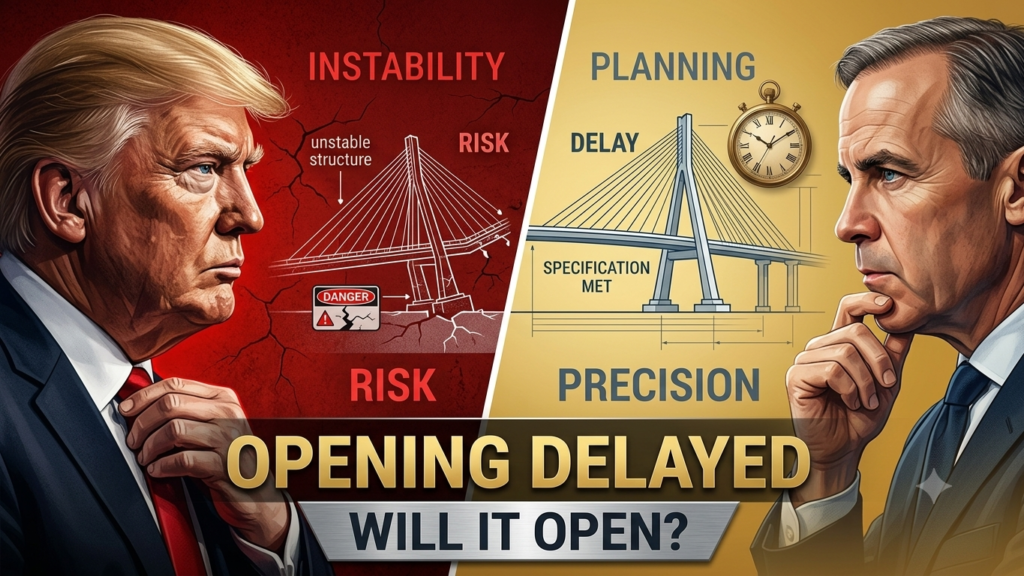
Behind-the-Scenes Diplomacy: Carney Meets Trump
As the rhetoric escalated, Canadian leadership moved quickly to de-escalate the situation through direct, high-level diplomatic channels. The day after the social media announcement, Canadian Prime Minister Mark Carney held a direct phone call with President Trump.
According to reports, Prime Minister Carney used the conversation to politely but firmly lay out the hard facts of the project:
Canada funded the entire $4.5 billion USD construction upfront.
Co-ownership is already equally split between Michigan and Canada.
The bridge was built by both American and Canadian trade unions using steel sourced from both nations.
Carney described the call as highly positive and collaborative, framing the bridge as a premier example of what the two countries can achieve when they work together.
However, the diplomatic resolution faced immediate friction. Just hours after the call, White House Press Secretary Karoline Leavitt reiterated the administration’s tough stance, stating that the White House found Canadian control of the land ports of entry on both sides “unacceptable” and would continue to push for greater American authority over security and economic benefits.
The Monopoly Factor: The Moroun Family’s Shadow
To fully understand the political undercurrents of this dispute, one must look back at the long history of opposition to the Gordie Howe Bridge. For over a decade, the primary opponent of the new crossing was not a government entity, but rather the Moroun family—the wealthy owners of the rival Ambassador Bridge.
For decades, the Ambassador Bridge enjoyed a highly lucrative, effective monopoly on commercial toll collection at the Detroit-Windsor crossing. The Moroun family spent millions of dollars in lobbying efforts, legal challenges, and television ad campaigns in an attempt to halt the Gordie Howe project and protect their monopoly.
During Trump’s first term, the family made direct appeals to the White House to stop the project. However, support for the new bridge remained stubbornly bipartisan at both the state and federal levels, with leaders recognizing that a single, privately-owned bridge was a dangerous single-point-of-failure for North American trade.
Deep Economic Integration: Why the Border Cannot Fail
The dispute over the Gordie Howe Bridge highlights a fundamental truth: the economies of the United States and Canada are not merely adjacent; they are deeply and irrevocably integrated.
[U.S. Auto Parts Manufacturer] ──(Crosses Border)──> [Canadian Assembly Plant]
                                                               │
[U.S. Consumer Market] <──────────(Crosses Border)─────────────┘
The Just-In-Time Supply Chain
Nowhere is this integration more visible than in the automotive industry. Under modern “just-in-time” manufacturing processes, automotive components do not simply get made in one country and shipped to another. Instead, a single car part might cross the U.S.-Canada border seven or eight times during its manufacturing assembly cycle before the finished vehicle finally rolls off the line.
The True Cost of a Shutdown
Because of this hyper-integration, any prolonged disruption or artificial barrier at the Windsor-Detroit border immediately threatens the livelihood of hundreds of thousands of workers. If the Gordie Howe Bridge were to remain closed, Canada would not lose its investment; the bridge is already built and paid for. Rather, it is the businesses, logistics networks, and workers of the American Midwest who would bear the brunt of the economic fallout.
Looking Forward: The Path to the Late 2026 Opening
Despite the political posturing and dramatic negotiations, common sense and economic necessity appear poised to win the day. By mid-2026, state and provincial leaders moved to assure the public that the bridge was still moving forward.
Michigan Governor Gretchen Whitmer confirmed that the bridge remains on track to open to the public in late 2026. State and provincial authorities have quietly continued final safety testing, customs technology installations, and road integration projects.
Most international trade observers expect that the bridge will open on schedule. While the federal administration may claim to have negotiated new “concessions” or oversight measures to satisfy domestic political narratives, the legally binding terms of the 2012 agreement remain intact. The immense economic pressure from the business community and the sheer physical reality of the completed bridge make its operation inevitable.
Conclusion: What We Build Together
The Gordie Howe International Bridge stands as a physical monument to what is possible when two sovereign nations share a vision of mutual prosperity. It represents the hard work of thousands of Canadian and American ironworkers, engineers, and planners who labored for years to build a structure designed to last a century.
While political administrations change and trade rhetoric will inevitably fluctuate, the inescapable logic of geography and economics remains. The United States and Canada are economic twins. By bridging the Detroit River with a state-of-the-art corridor, both nations have secured a faster, safer, and more prosperous future. In the end, the legacy of the bridge will match the legacy of its namesake: a symbol of strength, endurance, and the undeniable power of teamwork across borders.
FAQs
1. Who is paying for the construction of the Gordie Howe International Bridge?
The Canadian federal government is funding 100% of the upfront costs of the project, totaling approximately $6.4 billion Canadian dollars (about $4.5 billion USD). This includes the costs of land acquisition and building the ports of entry on both the Canadian and American sides of the border.
2. Does the United States own any portion of the bridge?
Yes. Under the terms of the signed 2012 Canada-Michigan Crossing Agreement, the bridge is co-owned 50/50 by the Canadian government and the State of Michigan.
3. How will Canada recover the billions of dollars spent on construction?
Canada will collect and retain 100% of the toll revenues generated by vehicles crossing the bridge. It is estimated that it will take approximately 30 years of toll collection to fully recoup the initial construction and acquisition costs.
4. Was American steel used to build the bridge?
Yes. Despite claims to the contrary, significant amounts of American-made steel and components were used in the construction, particularly on the Michigan side of the crossing. The project utilized labor and materials from both nations.
5. Why did the owners of the Ambassador Bridge oppose the project?
The Ambassador Bridge is privately owned by the Moroun family, who enjoyed a highly lucrative monopoly on commercial truck traffic across the Windsor-Detroit corridor for decades. They opposed the Gordie Howe Bridge to protect their market share and toll revenues.
6. When is the Gordie Howe International Bridge scheduled to open?
Despite the political disputes of early 2026, state and provincial officials, including Michigan Governor Gretchen Whitmer, have confirmed that the bridge is in its final testing phases and remains on track to open to traffic in late 2026.
Sources and Further Reading
Windsor-Detroit Bridge Authority (WDBA): Official project specifications, engineering designs, and the legal framework of the 2012 Canada-Michigan Crossing Agreement.
The Detroit News: Bipartisan op-eds, including statements from former Michigan Governor Rick Snyder regarding the economic benefits of the bridge for U.S. interests.
Michigan Department of Transportation (MDOT): Reports on interstate integration (I-75) and regional logistical benefits.