


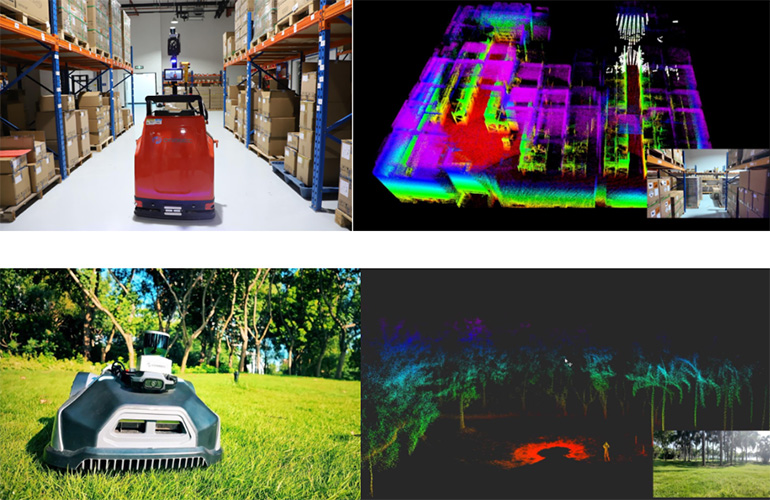
The Pulsar ME450 has been tested on robots like smart forklifts and lawn mowers, delivering high-quality point clouds for reliable navigation. Source: Orbbec
At the World Robot Conference 2025 in Beijing today, Orbbec unveiled the Pulsar ME450. Under the company’s “Flex to Flow” theme, the new sensor is intended to allows robotics applications to switch scanning modes instead of swapping devices, addressing diverse 3D perception requirements across multiple scenarios.
Orbbec said the Pulsar ME450 is a direct time-of-flight (dToF) 3D lidar using a combination of a micro-electromechanical systems (MEMS) mirror and a motor to offer configurable scanning patterns and adjustable vertical field of view.
“The Pulsar ME450 represents the industry’s first multi-pattern lidar combining high-precision MEMS pitch scanning with motorized azimuth control,” stated Guo Wei, head of the lidar research and development team at Orbbec. “By overcoming single-mode limitations, we’re delivering unprecedented flexibility and reliability for robotic environmental perception.”
Founded in 2013, Orbbec offers products spanning structured light, stereo vision, ToF, and lidar technologies. The Shenzhen, China-based company said its sensors power robots and manufacturing, logistics, retail, 3D scanning, healthcare, and fitness systems. With in-house R&D, state-of-the-art factory, supply chain management, and global support, Orbbec also offers OEM engagements for custom and embedded designs.


Pulsar ME450 enables both navigation, 3D reconstruction
Orbbec asserted that the Pulsar ME450 lidar can switch among non-repetitive scanning, non-dense repetitive scanning, and dense repetitive scanning. Combined with adjustable vertical field of view and rotation speeds, the sensor can adapt to various robotics use cases without the need for multiple dedicated devices, it said.
This adaptable design aligns with the evolving demands of robotics, noted Orbbec. Dynamic obstacle avoidance requires speed and real-time response, while mapping applications need dense point clouds for detailed reconstruction, said the company. The Pulsar ME450 is designed for smart forklifts, logistics robots, lawn mowers, and surveying equipment through adaptive pattern switching.
The Pulsar ME450’s ability to switch between multiple scanning patterns on the fly enables a single sensor to handle both navigation and fine-grained 3D reconstruction tasks. This can reduce system complexity, simplify integration, and lower the total cost of ownership (TCO) without compromising on performance or accuracy, said Orbbec.
It added that the system delivers millimeter-level precision with high-fidelity 3D reconstruction capabilities, while its advanced reflectivity detection maintains stable performance across diverse materials and challenging interference conditions.

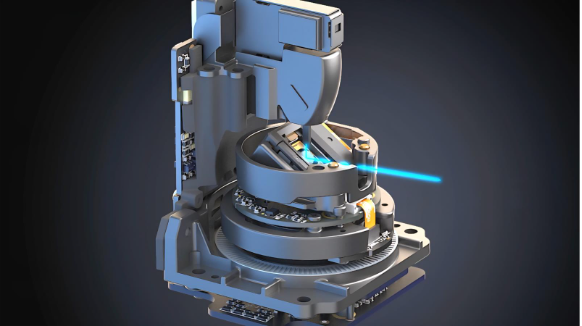
The Pulsar ME450 combines a MEMS mirror and a motor for configurable scanning patterns and an adjustable field of view. Source: Orbbec
Orbbec says innovations in robotic vision are ongoing
Orbbec said it has pioneered robotics sensor development in China since 2016. By 2023, the company captured over 70% market share in China’s service robot 3D vision sensor segment, according to GGII research. Orbbec now serves hundreds of robotics companies across nearly 100 countries and regions.
With foundational research in SPAD (single-photon avalanche diode) and depth perception, Orbbec launched the MS200 lidar sensor for autonomous systems in 2022. In 2024, the company’s LS635, a high-performance, back-illuminated SPAD system on chip (SoC) used advanced 3D stacking technology.
At ProMat 2025, Orbbec debuted the Pulsar SL450. The company asserted that the Pulsar ME450 launch represents its continued expansion in robotic perception. The company said its sensing portfolio can help robotics developers meet increasingly complex application demands and accelerate the evolution toward “truly capable embodied AI.”
