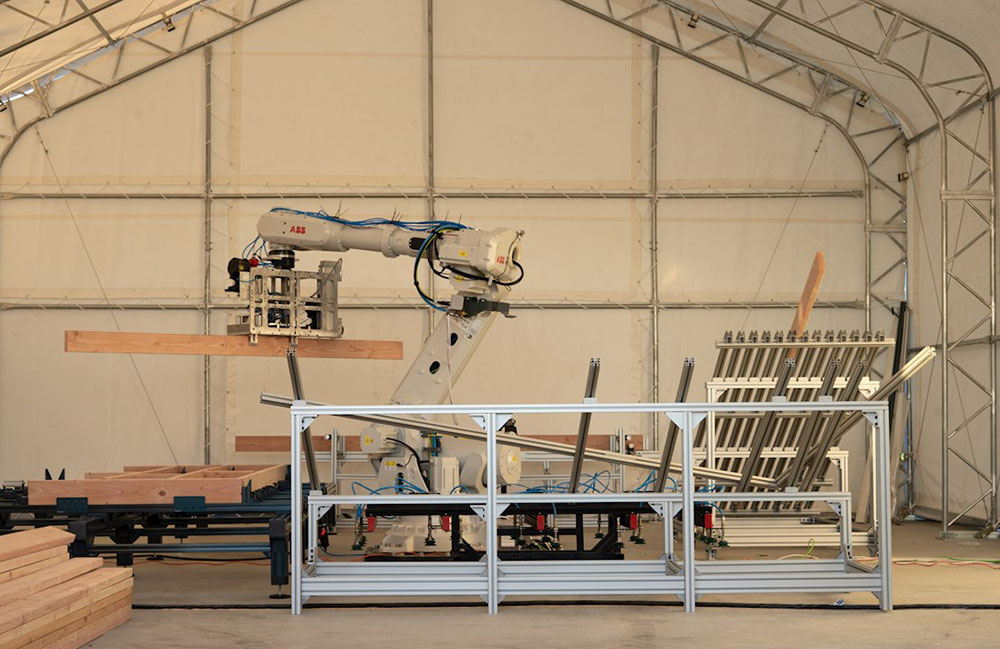
ABB said robotics can address construction industry challenges such as labor and skills shortages, sustainable resource use, and the need for affordable housing. | Source: ABB Robotics
Earlier this year, deadly wildfires raged through Southern California, destroying nearly 9,700 single-family homes, according to the Los Angeles Times. Now, ABB Robotics is working with Cosmic Buildings to rebuild with robots.
Through the collaboration, ABB and Cosmic are deploying a microfactory using artificial intelligence in Pacific Palisades, Calif., to build modular structures onsite.
“Together, Cosmic and ABB Robotics are rewriting the rules of construction and disaster recovery,” stated Marc Segura, president of ABB’s Robotics Division. “By integrating our robots and digital twin technologies into Cosmic’s AI-powered mobile microfactory, we’re enabling real-time, precision automation ideal for remote and disaster-affected sites. In the face of labor shortages and rising costs, this shows how automation can transform housing construction, by building faster, safer, and smarter.”
ABB Robotics & Discrete Automation is a leading provider of industrial robots, autonomous mobile robots (AMRs), and machine automation. In April, ABB Group announced plans to spin off the division, which employs about 11,000 people at more than 100 locations in 53 countries, including its North American headquarters in Auburn Hills, Mich.
Robots, AI ensure consistent quality, says Cosmic
ABB is integrating its IRB 6710 robots and RobotStudio digital twin software with Cosmic’s Robotic Workstation Cell and AI-driven building information model (BIM). The model is an end-to-end platform that handles design, permitting, procurement, robotic fabrication, and assembly, said the San Francisco-based company.
Within the on-site microfactory, ABB said these systems fabricate custom structural wall panels with millimeter precision and deliver them just in time for assembly at the construction site.
Launched in response to the devastating Palisades and Eaton fires, which destroyed more than 16,000 structures, Cosmic claimed that its mobile factory” marks a turning point for resilient, fast, and affordable housing solutions.” It aims to build 100 homes by 2027.
Cosmic integrates ABB’s RobotStudio into its AI BIM, enabling the entire build process to be simulated and optimized in a digital environment before deployment. Once on location, The company said its AI and computer vision systems work with the robots, making real-time decisions, detecting problems, and ensuring consistent quality.
In addition, Cosmic said it builds homes with non-combustible materials, solar and battery backup systems, and water independence through greywater recycling and renewable water generation. Each home exceeds California’s wildfire and energy efficiency codes, claimed the company.
“We’re not just building homes; we’re rebuilding the playbook,” said Sasha Jokic, the founder and CEO of Cosmic Buildings. “Our mobile microfactory is fast enough for disaster recovery, efficient enough to drastically lower costs, and smart enough not to compromise on quality. By integrating robotic automation with AI reasoning and on-site deployment, Cosmic achieves construction speeds three times faster than traditional methods, completing projects in as little as three months.”
The global construction robotics market is expected to experience a 20% compound annual growth rate (CAGR) until 2030, estimated ResearchGate, McKinsey, and Global Market Insights. TCosmic’s mobile microfactory could reduce construction time by up to 70% and lower total building costs by about 30% compared with conventional methods.
ABB noted that homes can be delivered in just 12 weeks at $550 to $700 per square foot, unlike Los Angeles’ typical $800 to $1,000+ range. The automated process also minimizes waste and improves build quality, easing the burden on homeowners facing underinsurance and inflated rebuilding costs, it said.
ABB makes other construction partnerships
ABB has also partnered with Automated Architecture (AUAR) to deploy microfactories. In March, ABB announced it will work with AUAR to build “ConstrucThor,” a research facility in Belgium to showcase advances in sustainable construction. The ConstrucThor project will create a climate-neutral, large-scale testing infrastructure at the OpenThor Living Lab in Thor Park, Genk, Belgium, the companies said.
AUAR and ABB previously collaborated on AUAR’s microfactories, which feature ABB robotic arms. The companies recently shipped two of the microfactories to the U.S. AUAR asserted that its microfactories can increase efficiencies, predictability, and oversight while also reducing financial risk and environmental costs when building timber homes.
Before working with AUAR, ABB said its robots have been used in modular assembly and 3D printing building projects worldwide. ABB robots have also been part of academic projects researching ways to integrate robotic automation into construction.