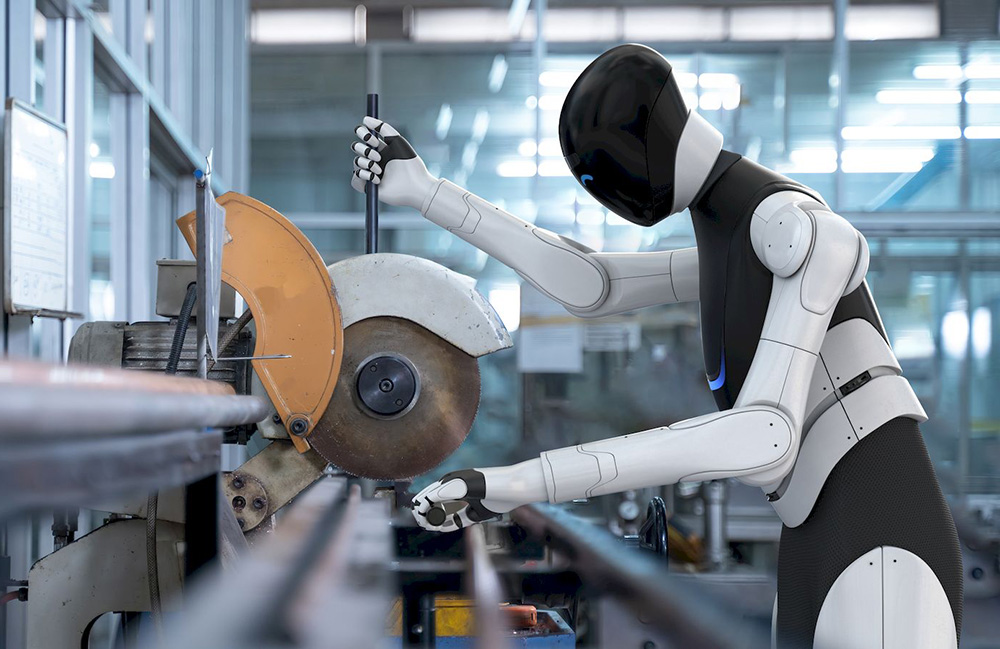
The IFR says that, thanks to their human-like dexterity and adaptability, humanoid robots could automate complex tasks that current robots struggle with using traditional programming methods. | Source: IFR
Humanoid robots have been making headlines in the robotics industry for a few years now. Around the world, robotics companies, private investors, and governments are racing to perfect this technology and apply it to the right use cases.
“Futuristic humanoids working in homes, businesses, and public spaces fuel people’s interest,” stated Takayuki Ito, president of the International Federation of Robotics (IFR). “Since our environment is optimized for the human body, the idea of a quick, universal helper to maintain manufacturing and services is evident.”
“If and when a mass adoption of humanoids will take place remains uncertain,” he acknowledged. “In any case, humanoids are not expected to replace the types of robots currently on the market in the future. Instead, they will complement and expand upon existing technology.”
China, the world’s largest market for industrial robots, has set specific targets for its plans to mass-produce humanoids. Meanwhile, tech companies in the U.S. and Europe are announcing significant funding. The vision is to create general-purpose robots based on human motion mechanics.
The IFR today released a paper on the “Vision and Reality” of humanoid robots, analyzing the trends, opportunities, and potential limitations of these emerging systems.
Humanoid adoption outlook by region
In the U.S., tech companies like NVIDIA, Amazon, and Tesla have invested heavily in artificial intelligence and robotics technologies. Besides military funding, a lot of private investments support this development, resulting in a large number of startups developing humanoid robots.
There is a strong interest in using humanoids in logistics and manufacturing, according to the IFR. These machines are seen as tools for enhancing productivity and efficiency rather than as social companions. The focus is more on practical applications and less on integrating robots into daily social life, said the organization.
Meanwhile, China has put humanoids at the center of its national strategy. The government wants to showcase its competencies and global competitiveness in this field of technology. There is a strong emphasis on using humanoids in service sectors, such as customer service.
The IFR noted that humanoid usage in manufacturing to automate production lines and reduce reliance on human labor seems to be a secondary priority for China. One key element of that country’s strategy is to establish a supply chain for key components that is scalable.
Japan has been a pioneer in the development of humanoid robots, with Honda’s Asimo being an early example unveiled in 2000. In Japan, robots are regarded as companions rather than mere tools, the IFR said.
Humanoid robots such as Pepper and Palro were designed primarily as social robots and are used in educational settings, commercial stores, and elder care facilities. This reflects the needs of Japan’s ageing society. The focus is on creating robots that can live harmoniously with humans and are accepted as part of society. Leading companies such as Kawasaki are developing humanoid robots as research platforms.
Europe places a strong emphasis on the ethical implications of robotics and AI, observed the IFR. The continent has a significant focus on collaborative robots that work alongside humans in industrial settings. The focus is on enhancing safety, efficiency, and human capabilities, rather than on replacing human workers.
In Europe, there is a focus on human-centric design and on the social and societal impact of robots, found the IFR. European businesses are more cautious about the use of humanoids to meet the automation needs of the manufacturing and service sectors in the short to medium term.

Learn more about humanoids at RoboBusiness
Don’t miss RoboBusiness 2025 on Oct. 15 and 16 in Santa Clara, Calif. The conference includes sessions focused on humanoid robot development and deployment, including a keynote panel on “Lessons Learned from First Humanoid Deployments.” Speakers will include Katlyn Lewicke, head of global automation strategy and intel at GXO Logistics, and Jim Fan, director of AI and a distinguished scientist at NVIDIA.
The humanoid track at RoboBusiness will also include sessions on:
- “Humanoids for Real Applications: Mastering Safety and Performance,” with Nikolai Ensslen, CEO of Synapticon
- “Advancements in Humanoid Actuation,” with Jordan Schaeffler, strategic business development engineer at Novanta
- “Integrating Behavioral Science into Humanoid Design,” with Ram Devarajulu, vice president and head of robotics for North America at Cambridge Consultants
RoboBusiness, the premiere event for developers and suppliers of commercial robots, will also have tracks on physical AI, enabling technologies, and design and development best practices. It will feature more than 60 speakers, a startup workshop, the annual Pitchfire competition, and numerous networking opportunities.
Over 100 exhibitors on the show floor will showcase their latest enabling technologies, products, and services. Registration is now open for RoboBusiness 2025.


