iRobot revenue declined 23.3% in Q2 of 2025. Source: iRobot
Most robotics companies would kill to earn $127.6 million in a quarter. But not iRobot Corp. The Roomba maker continued its financial slide, reporting that second-quarter 2025 revenue was down 23.3% year over year. The sharp decline highlights ongoing challenges for iRobot as it struggles with slowing demand, increased competition, and the aftermath of its failed acquisition by Amazon.
iRobot said its Q2 revenue increased 6% in Japan but declined 33% in the U.S. and decreased 17% in EMEA over the prior-year period. The company’s revenue in Q1 2025 was $101.6 million, which was a 32% drop year over year from $150 million.
iRobot CEO Gary Cohen acknowledged the results fell short of expectations, citing market challenges and slower-than-anticipated scaling of new product lines. While iRobot saw improvement in gross margins and operating efficiency, Cohen said the company’s cash position remains under strain, limiting flexibility and raising concerns about liquidity.
“While we made meaningful progress on gross margin expansion, tightened control over operating expenses, and improved net losses, our cash position continued to decline as we supported new product launches — posing ongoing challenges to liquidity and operational flexibility,” he said. “Although early consumer response to our latest product launches has been encouraging, broader market pressures and financial constraints remain significant hurdles to improved performance.”
Things have gotten so bad that iRobot has suspended future financial guidance and opted not to host an earnings call for the quarter. The company said its board is continuing a previously announced review of strategic alternatives, including a potential sale, strategic transaction, or refinancing of existing debt. No timeline has been set for the conclusion of the process.
As of June 28, iRobot’s cash and cash equivalents totaled $40.6 million, compared with $69.9 million as of March 29. Also as of June 28, it had an additional $36 million of restricted cash set aside for future repayment of its term loan.
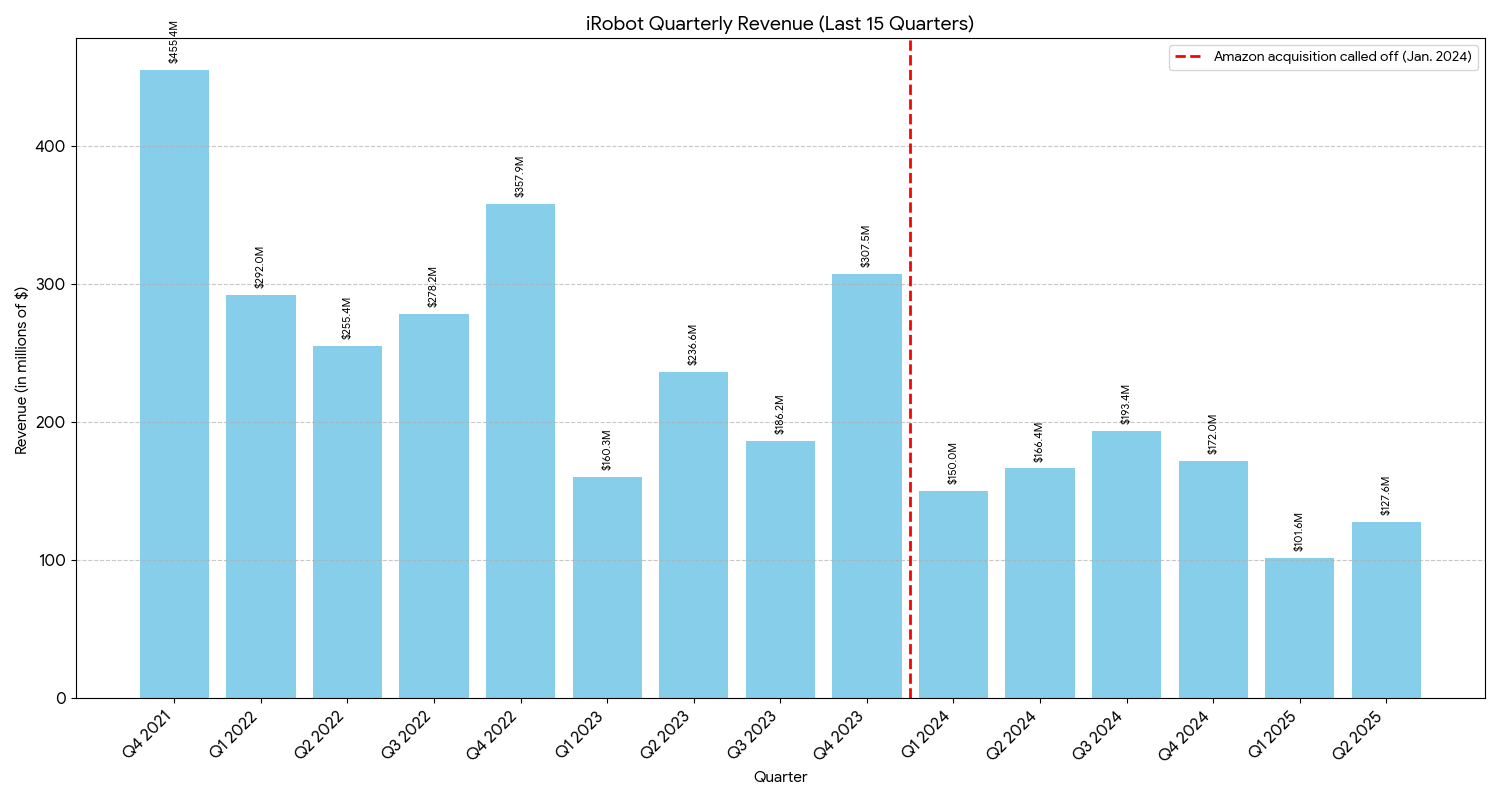
iRobot’s quarterly revenue has fallen over four years. (Click here to enlarge.) Chart created by Google Gemini and verified by The Robot Report.
iRobot struggles continue
Cohen inherited a mess when he was named CEO in May 2024. He joined just three months after Amazon terminated its $1.7 billion acquisition of iRobot. Cohen took over for longtime CEO Colin Angle, who held the position since 2007.
Angle left after the Amazon acquisition failed. He had founded Bedford, Mass.-based iRobot with fellow MIT roboticists Rodney Brooks and Helen Greiner in 1990.
Unfortunately, things have only gotten worse since Cohen took over the reins. iRobot has gone through multiple rounds of layoffs, with the last public axing taking place in November 2024. On top of the failed Amazon acquisition, increased competition and the inability to diversify its product line have put iRobot in its current predicament.
iRobot worked on a variety of robots before launching its Roomba robot vacuum in 2002. It has gone on to sell more than 50 million robots worldwide.
But the company struggled to diversify its consumer robotics portfolio, shelving a robot lawn mower it had been working on for nearly two decades. iRobot saw its share of the robotic vacuum market shrink in recent years due to increased competition, geopolitical challenges, and other issues.
Angle has quietly entered the home robotics space again with a new startup called Familiar Machines & Magic, currently operating in stealth mode. He’s joined by former iRobot CTO Chris Jones, robotics veteran Ira Renfrew, and others. The venture has already secured $15 million in funding.
What does the future hold for iRobot? Can it rebound? Will it be sold? Will it go out of business? Let us know your thoughts in the comments.